
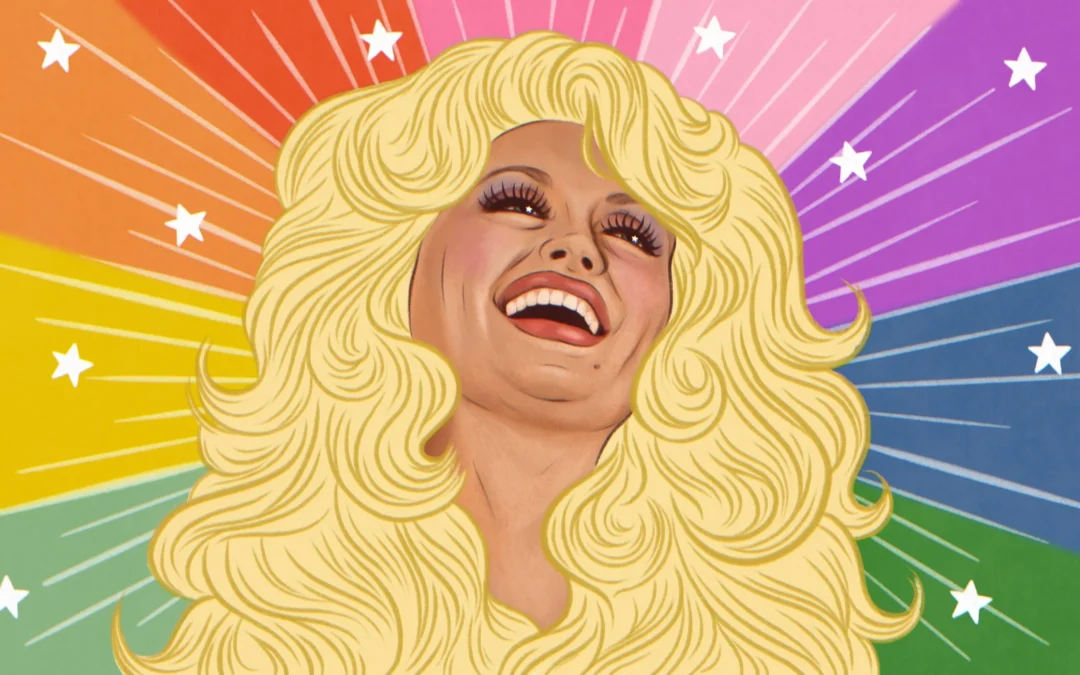
Illustration by Abigail Giuseppe
It’s been almost two weeks since Dolly Parton died, and I still find myself getting emotional about it.
More emotional, frankly, than I expected to be.
I wasn’t the kind of Dolly fan who listened to her music every day. I never got to see her in concert. I didn’t have some life-changing encounter with her or a story about meeting her backstage somewhere.
And yet, her death has hit me harder than the deaths of some people I actually knew.
I’ve been trying to figure out why.
I think part of it is simply that Dolly was always there.
For my entire life, she has been this constant, warm presence somewhere in the background of American culture. The big hair. The rhinestones. That unmistakable laugh. The smile. The music. The self-deprecating jokes. The ability to be completely over the top and somehow still feel completely genuine.
In a world that increasingly feels angry, exhausting and divided, Dolly seemed to occupy this rare little corner of it where kindness was still allowed to be uncomplicated.
She was bright without being fake.
Successful without seeming cruel.
Confident without needing to tear anyone else down.
And when everything around us felt a little too heavy, there was something comforting about knowing Dolly Parton was still out there somewhere being Dolly Parton.
Maybe I didn’t realize how much I depended on that.
There is another part of this that feels more personal.
Dolly and I both grew up poor in the rural South. Her circumstances were certainly harder than mine, but there are pieces of her story I have always understood instinctively.
When you grow up in a place where opportunities can feel limited, it can be hard to imagine a life much bigger than the one immediately in front of you.
Dolly did.
And then she built it.
Through an almost ridiculous amount of talent, hard work, determination and sheer force of personality, this girl from the mountains of Tennessee became one of the most recognizable people on Earth.
But what I admired most wasn’t simply that she became famous.
It was what she did with it.
She gave back. She created opportunities. She encouraged children to read. She supported people when they needed help. And somehow, despite becoming enormously wealthy and successful, she never seemed embarrassed by where she came from.
She carried it with her.
For those of us who grew up poor in the South and eventually found our way into rooms we weren’t necessarily raised to believe we would occupy, there was something incredibly powerful about that.
You don’t have to erase where you came from to become something more.
But I think there is another reason this loss has affected me so deeply.
Dolly Parton made people feel loved.
Not tolerated.
Not conditionally accepted.
Loved.
Growing up gay in a part of the South where being gay was — and in many places still is — frowned upon, unconditional love can feel like a surprisingly scarce resource.
You learn early that there may be conditions attached to people’s affection.
They love you, but they don’t understand “that part.”
They love you, but they wish you were different.
They love you, but maybe you shouldn’t talk about it.
They love you, provided you make yourself a little smaller and a little easier for them to accept.
Dolly never seemed interested in that kind of love.
She repeatedly made it clear that LGBTQ+ people deserved the same dignity, happiness and acceptance as anybody else.
No wink. No qualification. No theological footnote.
Just love.
And I think that’s one of the reasons so many LGBTQ+ people have loved her right back.
She saw us.
For people who spent portions of their lives wondering whether the world would ever fully accept them, Dolly Parton — this enormously famous woman from rural Tennessee — essentially looked at us and said: You are fine exactly as you are.
More than fine, actually.
You deserve to be happy.
You deserve to dream.
You deserve to become whoever it is you hope to become.
Maybe you had to grow up gay in the South to completely understand how powerful it was to hear that from someone like her.
So perhaps that is what I’m grieving.
Not simply a singer.
Not even really a celebrity.
I’m grieving a presence.
A reminder that kindness can coexist with ambition. That you can become wildly successful without becoming hardened. That where you begin doesn’t dictate where you end. That being yourself — loudly, colorfully, unapologetically yourself — can actually be one of your greatest strengths.
And maybe most importantly, that loving people doesn’t have to be complicated.
I didn’t realize how much I would miss Dolly Parton until she was gone.
I suspect a lot of people are discovering the same thing.
But I also have a feeling that Dolly is one of those rare people who won’t ever feel completely gone.
The songs will still play.
The movies will still make us laugh.
Children will continue receiving books because of something she started.
Dollywood will still sit there in the Tennessee mountains.
Someone somewhere will put on rhinestones when the world feels a little too gray.
And generations of people who never had the chance to exist on this Earth at the same time she did will still discover her and hear that voice for the first time.
Maybe that’s the reward for living a life as big and generous as hers.
Eventually the person leaves.
But the light doesn’t.
And something tells me Dolly’s will be around for a very long time.